
If you’ve ever stood at the kitchen counter staring at a stack of school papers, unopened mail, and a calendar you meant to update—while also trying to remember spirit day, a permission slip and what’s for dinner—you’re not disorganized. You’re carrying a too-heavy mental load, with no place to corral all the information that’s weighing you down.
Life comes at us from different directions: school, work, activities, appointments, packages, forms. Keeping all that info in your brain is exhausting. The solution? A family command center that serves as a visible home base for the details that keep everyone moving.
What a Family Command Center Is (and Isn’t)
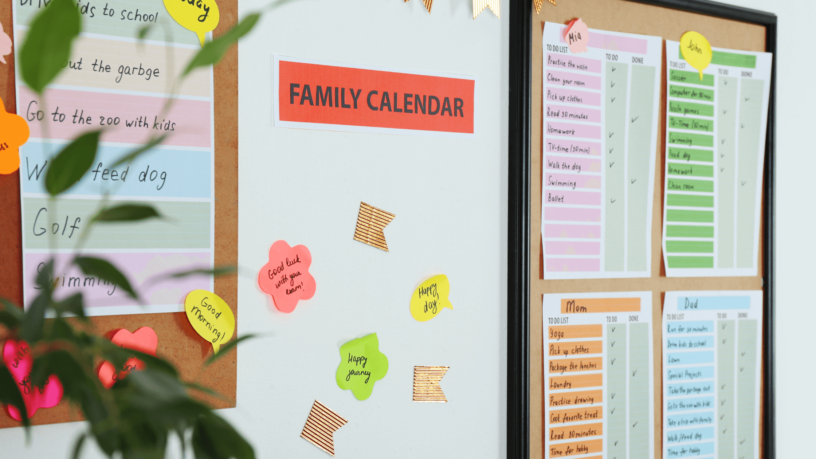
A family command center is a centralized, easy-to-access system that supports your household’s daily flow. It usually includes a family calendar, a landing zone for keys and backpacks, a home for school papers, and a simple way to communicate what matters this week.
\Your command center doesn’t have to look like a Pinterest project (although it certainly can if you want it to). It doesn’t require particular products or meticulous styling. Remember, our goal is simply to give you more peace by getting important info out of your brain and into a visible system. When that system is built around your real habits, it becomes the place your family naturally returns to, without you having to prod them.
The Power of One Centralized System
When families get stressed out, it’s usually not because of one big issue or crisis. Instead, they wear down from tiny moments repeated daily: the missing library book that’s due today. The growing pile (or piles!) of mail. The surprise announcement from your kid that they’re supposed to bring snacks to team practice today.
A command center works because it creates one predictable answer to recurring questions: “Where does this go?” and “Where do I find that?” When your family has a consistent landing zone, you spend less time searching, reminding and re-deciding. And that gives you back a lot of bandwidth.
Where to Create Your Command Center
If you want to know how to set up a family command center that actually gets used, start by answering this question: Where does your family naturally pause? Maybe it’s the garage entry, the hallway to the kitchen, or the spot where backpacks already hit the floor.
When we set up command centers for clients, we pay close attention to where papers pile up, where keys get dropped, where shoes accumulate, where the “I’ll deal with this later” stack is born. Your home is already telling you where the system needs to be.
If a command center looks good but doesn’t solve what’s actually going wrong in your day, it becomes decor with guilt attached. A well-designed command center feels like the house is cooperating with you.
Client Story: A Command Center for ADHD Kids
One of my favorite command center transformations was for a family with two elementary-aged kids, both with ADHD. Their mornings felt like a daily sprint – lots of motion, very little traction. Everyone was trying, and everyone ended the morning stressed.
Instead of placing the command center where it looked best, we placed it where it made the most sense: along their natural route from the garage and hallway into the main living area. In other words, we didn’t ask the family to start using a new spot. We built the system into the spot they already used.
Command centers work best when they’re kid-friendly. So we created a simple after-school rhythm that was easy to repeat: When they arrived home, backpacks were hung immediately. Shoes had a designated home. Homework came out and went into one consistent place (not “somewhere safe” that no one can locate later). Lunchboxes went straight to the kitchen. When homework was completed, it went right back into the backpack so mornings weren’t a scavenger hunt.
The command center put this family’s mornings on something close to autopilot: Load lunchboxes, put on shoes, go. And the household got a lot calmer thanks to a system that reduced the number of times a parent had to become the “human reminder app.”
Command Center Essentials (Keep It Simple)
The most effective command centers are usually the least complicated. You don’t need lots of different components or accessories. Just a few can solve the biggest recurring problems:
Family Calendar (the ‘Single Source of Truth’)
This is the heart of the command center. Whether you choose a large wall calendar or a digital display, what matters is that it becomes the one place the schedule lives. It also needs to be easy to update and easy to glance at. For some families, a digital option like the Skylight Digital Calendar is incredibly helpful because it’s easy to update from anywhere.
School-Paper Landing Zone
School papers are relentless. If they don’t have a home, they become counter clutter and then “mysteriously” disappear.
A simple solution is a designated spot for incoming papers and a separate spot for action items. The exact format can vary—folders, wall pockets, a contained bin—but the system should answer one big question: Where do we put this the second it enters the house, and how do we ensure the important items don’t get buried?
Hooks and Drop Zones
When things like keys, backpacks and even sunglasses don’t have a predictable home, they create last-minute panic when it’s time to go and they can’t be found. To plug this daily energy drain, give each family member a designated hook and a contained spot for shoes or sports gear.
A Simple Communication Hub
This does not need to be complicated. It can be a small whiteboard, a note area or even a consistent place for “today’s message.” A good communication hub keeps the week’s key details in one place, instead of in fragments around the house
Build Consistency (Gently)
A command center doesn’t fail because the bins weren’t labeled or the calendar wasn’t fancy enough. It gets abandoned when no one builds a routine to actually use it. Creating that routine that comes down to two things: communication and rhythm.
Communication means your household agrees on the basics. What goes here? When do we check it? What’s the new default? Without that agreement, everyone quietly drifts back to old habits, and the clutter creeps back onto every surface. Rhythm means picking one or two anchor moments for using the command center: a quick reset when everyone gets home, a glance at the calendar at dinner or before bed.
No one (including you) will use the command center perfectly, which is fine. The goal is simply making the system easy to return to when life gets busy. Eventually, the command center becomes the default.
When a center isn’t sticking, the fix is usually simpler than people expect: a lighter setup and a gentle, realistic routine that matches how your family already moves through the home.
From ‘I’m Always Behind’ to ‘We’ve Got This’
An effective command center gives you more than a tidy entryway. It changes how your day feels.
How much calmer would your life be if you never had to scramble in the morning looking for one kid’s permission slip and the other’s important homework? How much mental capacity could you free up if you didn’t have to remember dates and details for everyone in your family? Or if you weren’t managing a thousand invisible tasks?
As our clients start using their command centers, they feel more in sync with family members and more like their home is actually supporting them. They do not miss the constant reminders they used to have to give everyone.
And that’s the real win: Household calm you can actually maintain.
Ready for a Command Center That Keeps Working?
If you want a command center that fits your home and family, but you don’t want to spend weeks researching, buying, returning and redoing, I’d love to help.
Our clients are deeply capable people with demanding careers and full personal lives. They need a system implemented quickly and thoughtfully, without turning it into another weekend-eating project.
Having someone set up your command center can shortcut months of trial and error. We can identify the friction points, choose the best location and create a layout based on how your family actually moves. Our solution-based systems are simple to maintain, so the command center doesn’t become one more thing you “should” keep up with.
Learn more about our home-organizing services and how we can make daily life in your house feel lighter. Next, schedule a Connection Call . We’ll talk through what’s driving your stress, what would make the biggest difference, and what an effective command center could look like for your household.